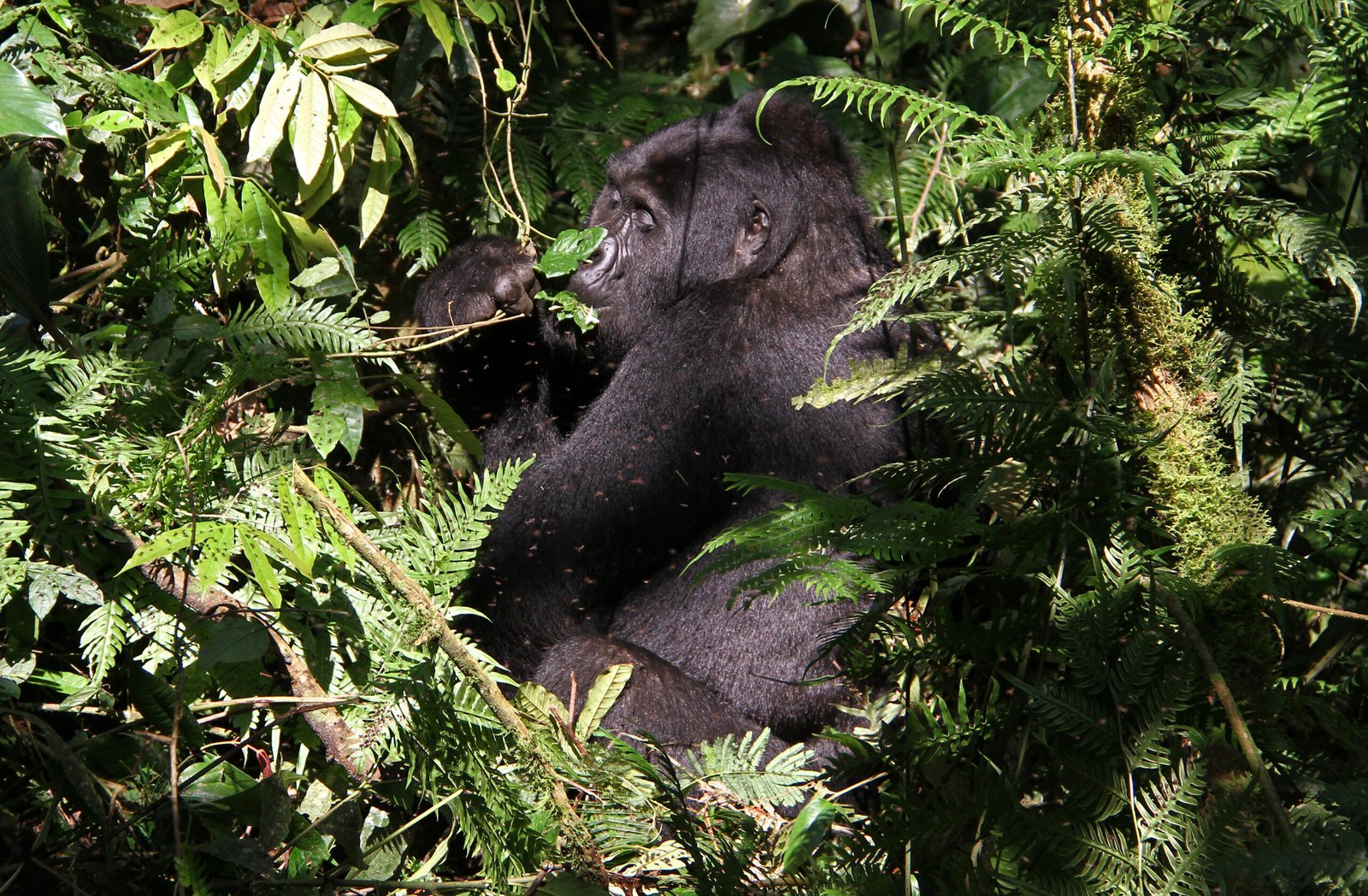
Primate Capital of the World
Chimpanzee Tracking
About Chimpanzee Tracking
Kibale Forest National Park, known as the “Primate Capital of the World,” is home to over 1,500 chimpanzees and 12 other primate species. Chimpanzee tracking here offers visitors the rare opportunity to observe our closest relatives in the wild, as they swing through the forest canopy, forage for food, and interact in complex social groups.
Guided by experienced rangers, you’ll learn about chimpanzee behavior, ecology, and the conservation efforts protecting them. The treks are conducted twice daily (morning and afternoon), and each experience lasts 2–5 hours depending on chimpanzee movements.
Highlights of the Trek
- Close-up encounters with wild chimpanzees in their natural habitat.
- Insightful guidance from expert rangers and trackers.
- Opportunities to see other primates like red colobus and L’Hoest’s monkeys.
- Rich biodiversity of Kibale Forest including butterflies, birds, and plants.
- Immersive jungle trekking through lush tropical rainforest.
Visitor Information
Best Time to Visit: June to September and December to February (dry seasons).
Duration: 2 – 5 hours depending on chimpanzee location.
Difficulty: Easy to moderate walking — suitable for most fitness levels.
Permit Required: Chimpanzee tracking permits are mandatory (book in advance).
What to Bring: Hiking shoes, long trousers, rain jacket, insect repellent, water, and a camera.
Chimpanzee trekking
Chimpanzee trekking refers to visiting chimpanzees in their natural environment. The chimpanzee trekking activity starts early morning with a briefing about the dos and don’ts at the forest headquarters. You are later grouped in groups of members, each with park guides and rangers who lead you to the forest for your chimpanzee experience. The trek takes 30 minutes to hours, depending on the movement of the chimpanzees. Once the chimps are found, you will stay for one hour or four hours with these amazing creatures to watch them eating, resting, and playing. The trek gives chances of viewing other primates, reptiles, and mammals like the forest elephants, monkeys, and butterflies, depending on your luck. There are three sessions for chimpanzee trekking, namely, the morning session that starts at 8:00am, the mid-morning session that starts at midday, and the afternoon session that starts at 2pm throughout the year.
Where is chimpanzee trekking done in Uganda?
Kibale Forest National Park
Kibale National Park is one of the best places in Africa where you can see chimpanzees in their natural environment. Chimpanzees are among the endangered species in the world. Kibale National Park is referred to as the primate capital, having about 20 primate species, which is the highest density in all of Africa. Chimpanzees are the second most famous primates after the mountain gorillas, and they also have 95% human DNA. Planning a chimpanzee safari to Kibale is one of the lifetime experiences you will enjoy in Africa. Kibale Forest National Park is located in western Uganda, covering the districts of Kabarole, Kyenjonjo, Kamwenge, and Kyegegwa. Kibale Forest National Park is a tropical forest and is a habitat of a number of forest wildlife, about 1500 chimpanzees, bird species, tree species, reptiles, monkeys, butterflies, mammals, and other wildlife. The road trip from Kampala/Entebbe is about a 4-5-hour drive.
What is the cost of chimpanzee trekking permits for Kibale Forest National Park?
The chimpanzee trekking permits are very essential for your visit to see the chimpanzees in Kibale Forest National Park. The chimpanzee permits are bought from the offices of the Uganda Wildlife Authority in Kampala, and the permit price is inclusive of the entrance fees and guiding fees. According to the UWA-Tariff for 2021-2022, the chimpanzee trekking permit is issued to those interested in seeing the chimpanzees that are already used to people and only allows one hour of viewing and staying with the chimpanzee once you find them. This permit costs USD 200 per person for non-foreign residents, USD 150 per person for foreign residents, and 150,000 Ugandan shillings per person for East African citizens. There is also a chimpanzee habituation permit that allows you to see the chimpanzees for 4 hours; the permit costs USD 250 for non-foreign residents, 200 for foreign residents, and UGX 200,000 for citizens.
Kalinzu Forest is located close to Queen Elizabeth National Park and Maramagambo Forest in the Bushenyi district, Western Uganda. The forest has about 414 species of trees; it harbors 378 species of birds, six different species of primates (blue monkeys, vervet monkeys, black and white colobus monkeys, and chimpanzees), 262 butterflies, 97 moths, reptiles, and flowers. Chimpanzee trekking in Kalinzu Forest is one of the major activities done in this forest, and many who have done it have had an experience worth the money spent.
What is the cost of chimpanzee trekking in the Kalinzu forest?
The cost of chimpanzee trekking in Kalinzu Forest depends on the number of days to spend and the places to stay on your safari to Kalinzu Forest for this activity. A chimpanzee trekking permit costs $50 for a foreign non-resident and $50 for a resident per person per trek. This permit gives you an opportunity to spend a 1-hour encounter with the habituated chimpanzees in Kalinzu Forest. On top of the permit, you will also pay for other services for a successful chimpanzee trekking in Kalinzu Forest, which include transport, accommodation, and guiding.
Kyambura Gorge in Queen Elizabeth National Park
Kyambura Gorge is located in Queen Elizabeth National Park, Western Uganda. The gorge was established to work as a buffer zone of Queen Elizabeth National Park. It is home to different species of primates, best known for chimpanzees, vervet monkeys, black and white colobus monkeys, butterflies, moths, reptiles, and flowers. Chimpanzee trekking in Kyambura Gorge is one of the major activities done in this forest, and many who have done it have had an experience worth the money spent.
What is the cost of chimpanzee trekking in Kyambura Gorge?
The cost of chimpanzee trekking in Kyambura Gorge depends on the number of days to spend and the places to stay on your safari to Kyambura Gorge for this activity. A chimpanzee trekking permit costs $50 for a foreign non-resident and $50 for a resident per person per trek. This permit gives you an opportunity to spend a 1-hour encounter with the habituated chimpanzees in Kyambura Gorge. On top of the permit, you will also pay for other services for a successful chimpanzee trekking in Kyambura Gorge, which include transport, accommodation, and guiding.
Budongo Forest, Murchison Falls National Park
Budongo Forest Reserve is a tropical rainforest located in Murchison Falls National Park in northwestern Uganda in the Masindi district. Budongo is a 4-5 hour drive from Kampala City/Entebbe and offers an opportunity to trek and see chimpanzees in their natural habitat. Other primates that can be observed are the Black-and-White Colobus Monkeys, Olive Baboons, Red-tailed Monkeys, Blue Monkeys, and Grey-cheeked Mangabeys.
What is the cost of chimpanzee trekking in Budongo Forest?
Chimpanzee trekking in Budongo Forest Reserve is managed by Ugandan lodges licensed by the National Forestry Authority and the Uganda Wildlife Authority. The chimpanzee trekking permit is essential and is issued for those interested in seeing the chimpanzees that are already used to people and only allows one hour of viewing and staying with the chimpanzee once you find them. This permit costs USD 130 per person for non-foreign residents, USD 120 per person for foreign residents, and USD 85 per person for Ugandan citizens. There are two sessions for chimpanzee trekking in Budongo Forest: the morning session that starts at 8:00am and the afternoon session that starts at midday throughout the year. Both sessions are very safe for chimpanzee trekking in Budongo Forest.
Best time to do chimpanzee trekking in Uganda
The best time to do chimpanzee trekking in Uganda is during the months of June to October and December to March. During this time it is a dry season in Uganda with mild rainfall, making it easy for the treks in the forests. Also, during this time the vegetation is not fully grown, and it is easy to view the chimpanzees, offering great sights for photographs. During the other months of April, May, and November, which is normally a wet season, this makes the vegetation grow high, making the sightings unclear; however, during this time, the treks tend to be shorter, given the fact that chimpanzees don’t move further distances looking for food, as food is readily available in the forest compared to the dry seasons.
Chimpanzee trekking in Rwanda, Nyungwe Forest National Park
The Nyungwe Forest National Park is one of the oldest rainforests in Africa, rich in biodiversity and spectacularly beautiful. It is home to more than 1050 plant species, 250 endemic Albertine rifts, 200 orchids, at least 120 butterfly species, 85 mammal species, 38 reptiles, and many more. The park is located in southwestern Rwanda, on the border with Burundi, where it is contiguous with the Kibira National Park to the south and Lake Kivu and the Democratic Republic of the Congo to the west.
Cost of chimpanzee trekking in Rwanda
The cost of chimpanzee trekking in Nyungwe Forest National Park depends on the number of days to spend and the places to stay on your safari to Nyungwe Forest National Park for this activity. A chimpanzee trekking permit costs $90 per person per trek; this permit gives you an opportunity to spend 1 hour encountering the habituated chimpanzees in Nyungwe Forest National Park. On top of the permit, you will also pay for other services for a successful chimpanzee trekking in Nyungwe Forest National Park, which include transport, accommodation, and guiding.
Best time to do chimpanzee trekking in Rwanda
The best time to do chimpanzee trekking in Nyungwe Forest National Park is during the months of June to October and December to March. During this time it is a dry season in Rwanda with mild rainfall, making it easy for the treks in the forests. Also, during this time the vegetation is not fully grown, and it is easy to view the chimpanzees, offering great sights for photographs. During the other months of April, May, and November, which is normally a wet season, this makes the vegetation grow high, making the sightings unclear; however, during this time, the treks tend to be shorter, given the fact that chimpanzees don’t move further distances looking for food. Food is readily available in the forest compared to the dry seasons.